New Currents: The Sallow Man at Sea
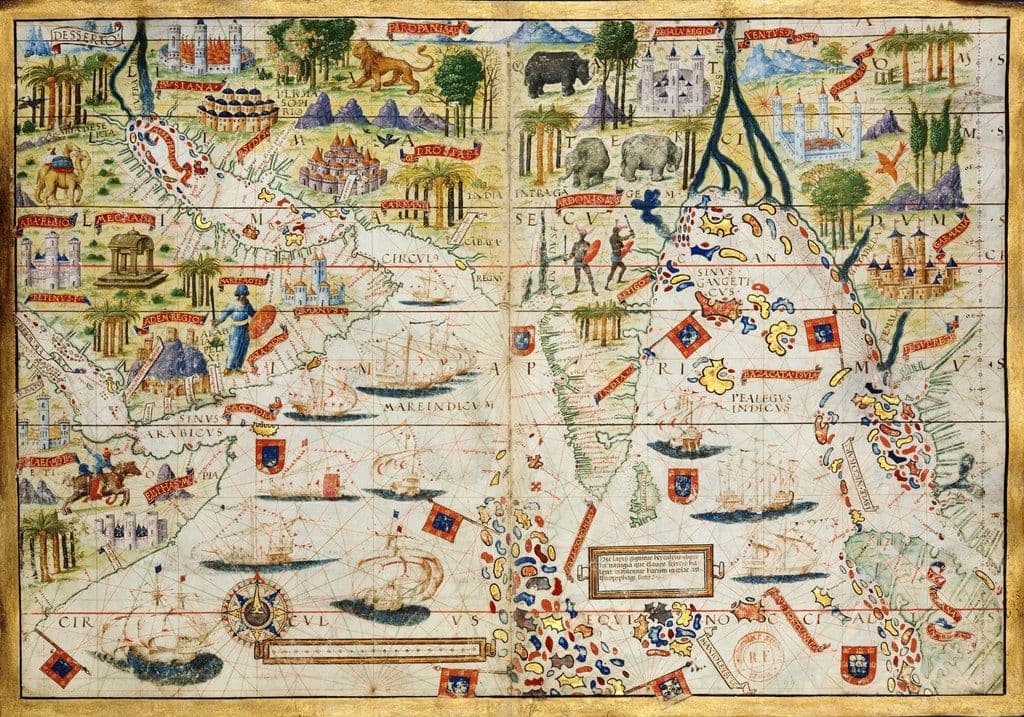
Across the Indian Ocean, the flows of people, labour and ideas have shaped the architecture and spatial politics of port cities. In this guest contribution for the Nieuwe Instituut's New Currents: Indian Ocean Futures, artists Lou Mo and Musquiqui Chihying trace the historical journeys of members of the Chinese Hakka community in Mauritius and Réunion Island. Combining historical research with traditional poetry, the artists reflect on the continuing influence of past systems of migration and control on life in the region today.
30 March 2026
Words by Lou Mo and Musquiqui Chihying
The Asian diaspora has long been connected to the Indian Ocean islands and the East African coast, and the myths, mysteries and ambitions borne on its tides. In our research into the Chinese Hakka community, we have traced their historical journeys to Mauritius and Réunion Island. We have realised that the 19th-century world of indentured servitude and unfreedom is not a romanticised historical backdrop, but is closely connected to today’s Indo-Pacific issues of control and connectivity.
Sallow Folks at Sea! At Sea! At Sea!
Out of the field,
To the ports and seas we go!
The sallow man crosses the southern sea,
Seeking futures and riches
On the other side of this sable and sallow sea.
With his gods he sails,
Gold rush, sugar rush, toward the Ocean he rushed!
Free, bonded, what are you looking for?
In late 2022, with our mutual interest in Afro-Asian connections, we began to discuss the possibility of collaborating on a research and documentary project. However, we have now shifted our focus away from contemporary geopolitics, to an interstitial time period and a group of people that captivated us both.
Our inquiry began with the Chinese Hakka community. The very etymology of the word ‘Hakka’ (客家)—with 客 meaning ‘guest’ or ‘outsider’ – reveals that this identity is not a fixed or homogeneous ethnicity, but is rather historically layered and shaped through waves of migration and continual displacement. Legendary travellers throughout Chinese history, the Hakka have spread all over the globe. Yet they hold onto a shared identity.
By studying their itineraries, we learned about the history of the 19th-century system of indentured labour in the Indian Ocean, the body of water between Africa and Asia. This particular period, spanning the transition from slavery to independence, became our focus, with the intermediate status between the enslaved and the free as our point of departure. During this period, the Indian Ocean was a crossroads for European, African Malagasy, Indian and Chinese populations. In particular, we wanted to explore this era through the lens of the Chinese migrants — the unnamed Sallow Men — who arrived on these faraway island worlds that were totally strange to them.
Terre! Terre!
An almost paradisiac island,
The pearl of the Indian Ocean.
There, you see your father for the first time.
There, this land of no one will become your new home.
The Sallow Man would step ashore at an immigration and quarantine depot, where he would discover people both similar to and different from himself. From there, he would learn to adapt to life on a tropical plantation island such as Mauritius and La Réunion. Sometimes, he would join earlier generations of the diaspora, perhaps meeting a father or an uncle. As he navigated working as an indentured labourer, also known as a ‘coolie’, or as a free immigrant running a small business, he encountered both formal colonial systems and informal ethnic ones.
We are curious about his experiences and feelings: the itineraries he followed, the sights and sounds he experienced, and the people and situations he encountered and what he thought about them. Many of these experiences are undocumented, so we can only imagine them. The verses interspersed in this text are from such an imaginary account, entitled The Sallow Sea, with a nod to the Sable Venus and Huang Zunxian (黃遵憲).
The mid-19th century was a time of transition for people caught between freedom and unfreedom, and an age of technological leaps which became increasingly available to colonial administrators. With the advent of steamships, sea voyages changed. With the advent of photography, indentured labourers and foreign immigrants could be documented with biometric precision. Notably, photography changed the way empires thought about controlling populations and identities.
Venturing through waves in Afrasia,
finding solace in the sweetness of cane juice on Mauritius islands.
Struggling relentlessly to carve through mountains,
protected by the blessings of Guandi.
Navigating through the vast expanse of Sallow seas,
Feeling as guests wherever one goes.
Undersea cables connecting islands,
weaving dreams with optimal fibre.
Labour transforms into information,
portraits uploading to the clouds.
In the city of artificial intelligence,
there’s nowhere to hide!
亞非搏浪波,毛島蔗甘露。
鑿山盡力苦,關帝佑宇安。
渺渺蕉色海,隨處為客家。
海纜連島嶼,光纖夢網織。
苦力化資訊,肖像上雲端。
人工智慧城,無處可遁形!
Today, more than a century later, one might ask: what is the relevance of this inquiry? What can it tell us about the world today?
The answer lies in seeing further than the terrestrial view and understanding the world’s interconnectedness through its waters, which make up 70 per cent of our planet. Throughout the long 19th century, the world became a colonial continuum once again, with the indentured labour system as a final experiment. The Atlantic and the Indo-Pacific were entangled through routes, peoples, legends and goods. This memory has not been forgotten, but has been dispersed and reabsorbed by all its heirs. The ports from which steam ships once sailed are now woven together by undersea cables that are invisible yet forever transmitting. History peeks through and competition is reproduced in today’s geopolitical zones and spheres of influence. The Maritime Silk Road gives a new look to an old idea. India’s SAGAR initiative is expanding to become MAHASAGAR precisely because the ocean is vast and touches many shores. The United States still controls Diego Garcia via the UK.
“ The ports from which steam ships once sailed are now woven together by undersea cables that are invisible yet forever transmitting. ”
Furthermore, technology is constantly changing and evolving. It has become such a ubiquitous part of our lives that we are often not aware of its presence. Focusing on the pivotal moment when the daguerreotype worked its magic with light to capture a likeness in a perfect image allows us to examine in detail the relationship between technology and its ability to exercise control. The world we live in now is one of constant data collection and surveillance in which the internet of things is always embedded. The concept of the smart city remains fuzzy: its definition varies from person to person, and its embodiment is different in the eye of every beholder. It is nevertheless associated with basic ideas such as being able to providing better infrastructure, demonstrating progressiveness, offering economic development and improving future-oriented efficiency. It seems like a worthy goal. Islands remain the ideal laboratory. Experimental smart cities dot the ocean’s coasts from Malaysia and Singapore to Mauritius, and stakeholders include not only nations but also corporations.
In an ICT dominated society, one might ask: who is striving to control what? If it was plantations yesterday, is it data today? Fundamentally, different groups of people are on either side of the surveillance camera, the monitoring screen and the automated border control machine. The conditions of unfreedom and non-citizenship endured by many, whether we call them migrant or gig workers today, also originate from the same post-abolition tendency to categorise and alienate.
This inquiry, which bridges the past and present, is therefore more pertinent than ever. The Sallow Sea is a metaphor for this, and we hope to offer a sensitive examination of the impact of the Ghosts of Empire Past on the future.
Musquiqui Chihying is a visual artist and filmmaker based in Taipei and Berlin. Working with moving images, sound and music, he explores postcolonial identity, Afro-Asian maritime histories and the politics of technology in the Global South. His work has been shown at Centre Pompidou, HKW Berlin and the Berlinale, among others.
Lou Mo is a Chinese Canadian artist and curator based in France. Her research focuses on Afro-Asian connections and Third World artists' creative practices, with interests in diaspora, identity and postcolonial history. As a member of the School of Mutants collective, her work has been shown at the Taipei Biennial, Centre Pompidou Metz and the Berlin Biennial, among others.
About New Currents: Indian Ocean Futures
New Currents: Indian Ocean Futures is a research project by the Nieuwe Instituut that connects a global network of researchers, artists and curators. They work together to explore and map the different stories of the Indian Ocean as ‘currents’, highlighting historical legacies that are still important today. The key aim is to encourage communication and collaboration across the region.